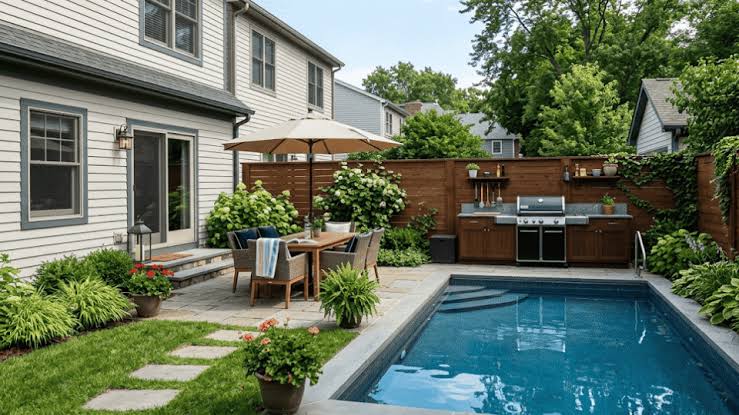

A compact pool yard works better when people who do not swim have a comfortable reason to stay outside. Reserve their space as deliberately as the water area. A shaded seat, a place to set down a book and an easy route back to the house can make the yard feel shared, even when household members want different things from the afternoon.
Count the people outside the water
Begin by describing the regular users without dividing them into swimmers and spectators. Someone may enjoy gardening beside the pool, another may prefer reading, and a visiting relative may want conversation without getting wet. These are legitimate uses of the property. Treating them as secondary can produce a beautiful pool surrounded by places where nobody settles comfortably.
Consider a normal day before a large party. The family member who spends an hour outdoors most evenings deserves more attention than an imagined crowd visiting once a year. Write down where that person would sit and what they would bring. If the plan has no suitable answer for a familiar activity, it is not yet a complete backyard plan.
Keep the expected group realistic. A compact yard cannot provide every possible recreation zone at once. The useful negotiation is between activities the household actually values. Preserving a pleasant place for two people to talk may be worth more than increasing the water area slightly, especially if those conversations are part of most evenings outside.
Personal comfort is specific. One person wants a seat with arms, another wants a clear view of the garden, and a third wants to avoid being in the middle of foot traffic. Invite those preferences into the design discussion. Asking everyone to imagine themselves in a generic lounge chair rarely reveals the differences that matter.
Keep the conversation in one comfortable place
Social space is about relationships as much as area. Two chairs located wherever they fit may leave their occupants facing away from one another. A table can connect the seats but also interrupt a route. Test the group as a small outdoor room, considering what people face, where their belongings go and how someone joins the conversation.
When comparing project approaches, explore the pool and landscape services together. Jameson Pool & Spa presents pool construction and surrounding landscaping as connected parts of its offering. That provides a useful starting point for asking how the design accommodates people who remain outside the water, rather than choosing a pool first and fitting chairs around it afterwards.
Look at comfort through the hours when the yard is used. Take notes on where sunlight falls on the existing property during those times. Bring the observations to the designer instead of assuming a proposed shade element will behave like one in a photograph. The final choice also needs professional consideration of the site and any applicable requirements.
Conversation does not require every seat to be at the pool edge. A nearby arrangement can still feel connected if its view and orientation make sense. Avoid turning physical closeness into a substitute for the household’s safety practices. An adult’s convenient seat does not define or discharge supervision responsibilities around children or other people who need support.
Test storage and service movement against the compact layout
Small yards reveal objects that larger properties can hide. A stack of cushions, a folded umbrella and a collection of pool toys can occupy the only comfortable walking space. Discuss their storage before selecting furniture. The goal is to give ordinary belongings a home, so the social area does not become the place everything waits to be put away.
Give each storage idea a use test. Where will the person stand when opening the lid or door? Can a lounger be moved without lifting it over another chair? Does a storage unit need to be emptied before its contents can be reached? These are modest questions, but they distinguish practical capacity from the volume printed in a product description.
The pool team also needs appropriate access to the equipment and parts of the installation it will service. Have the relevant professionals identify those needs on the plan. Screening can make equipment less visually prominent, but it should be designed around the required access and operating conditions. A decorative enclosure chosen independently can introduce problems the drawing did not anticipate.
Remember the work that continues beyond swimming. A gardener carrying supplies, a service technician arriving for an appointment and someone bringing dinner outside all use the property differently. Ask the designer to walk through those routes. A compact layout should not depend on moving the entire seating area every time a routine task occurs.
Choose the pool as part of the gathering
Review the proposed pool dimensions with the social plan visible. Discuss the swimming activities the household expects and ask the builder how the proposed shape, steps and interior features serve them. This keeps the decision focused on usable experiences. A larger outline is not necessarily more useful if it removes the dry space that makes the yard appealing to half its users.
Some compromises can remain flexible. Furniture can be selected to support different arrangements, and planting ideas can be refined with a landscape professional. Other decisions become more consequential during construction. Ask which adjustments should be resolved now and which can wait, so the household spends its attention on the parts that would be difficult to revisit.
At the last layout review, imagine the least enthusiastic swimmer in the household stepping outdoors with a drink and a book. Give that person a comfortable destination, a view they enjoy and a reason to linger. Their willingness to remain in the yard is a persuasive test of whether the pool project has created a place for everyone.